


The Pope Is Right. That May Not Be Enough.

On Magnifica Humanitas*, and the gap a novel lives in* or The Pope can name the humane path, but will anyone with power walk it before the cost becomes irreversible.
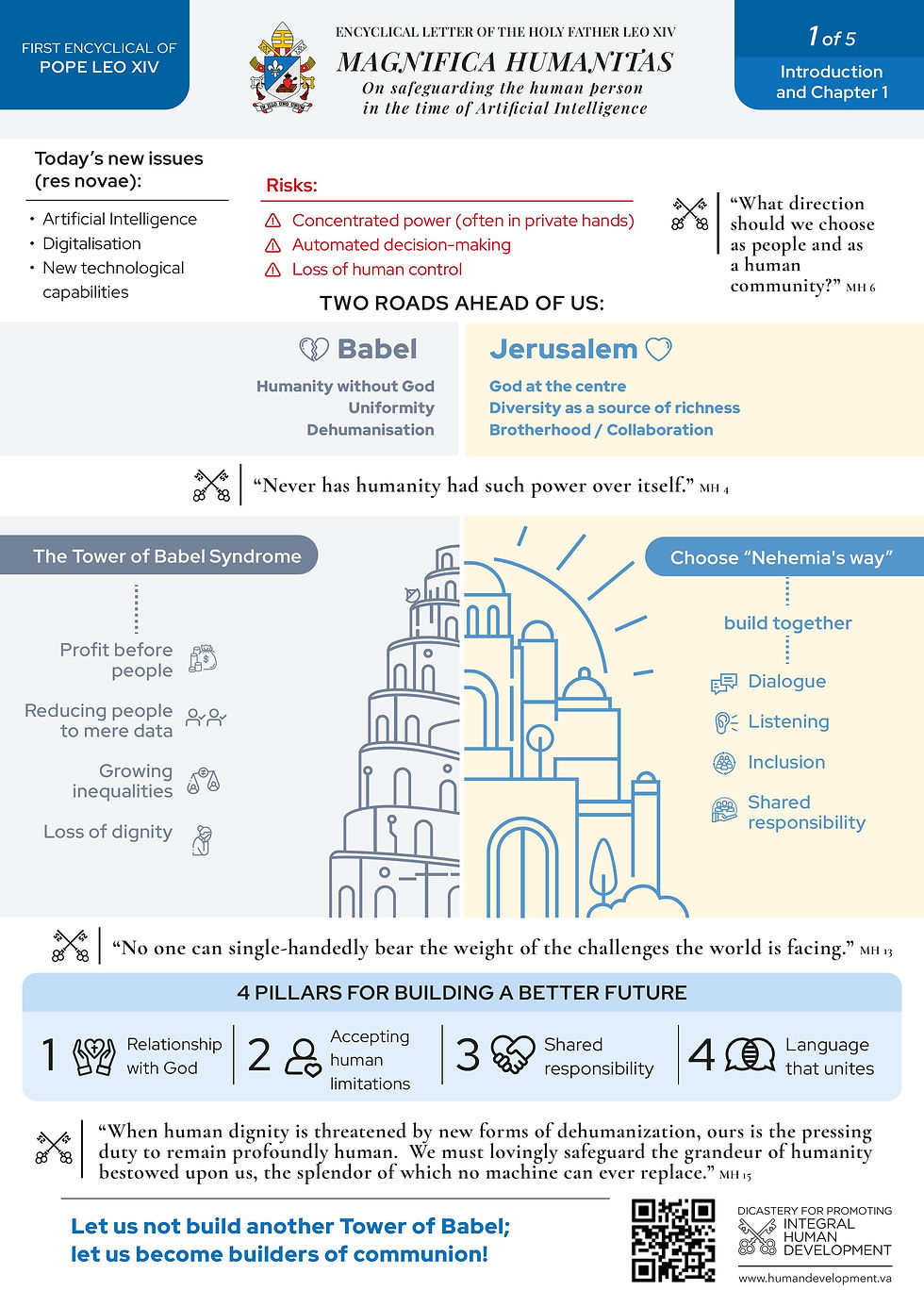
On the twenty-fifth of May, the Vatican released Magnifica Humanitas, Leo XIV's first encyclical, on safeguarding the human person in the age of artificial intelligence. I read it with a strange mixture of mental vindication from someone tinkering in their corner and wondering if they are over-thinking, but also unease.
The soon-to-be-released second book, Growing Pains, argues a version of what the encyclical argues. Earth First is, underneath the satellites and the engineered octopus and the long quarrel about whether biology has overtaken physics as the dominant engineering discipline, a single sustained worry — that the danger of a powerful technology is not that it turns against us, but that it serves us exactly as designed, and that what it is designed to serve is whatever its makers were already chasing. Advantage. Comfort. The removal of friction. Technology is never neutral, because it takes on the characteristics of those who devise it, finance it, regulate it, and use it. I could have used that sentence as an epigraph. I may yet in Book 3.
So let me be clear about the agreement before I complain. I think Leo XIV is right. The framing is right: this is a second industrial revolution and deserves the same seriousness the Church gave the first. The lineage is right; the document is dated to the 135th anniversary of Rerum Novarum, Leo XIII's 1891 answer to the upheavals of the factory age, and it carries forward that encyclical's oldest insight, the primacy of the human person over any mindset focused only on finance or productivity. The diagnosis is correct. Human dignity is the thing under pressure, and it is under pressure from within: from our own preferences, gently and continuously satisfied; far more than from any imagined machine waking up with intentions of its own. My fiction is, in large part, a long dramatization of exactly that. The guardrails in my books are not defeated. They are removed, voluntarily, by people who have been made comfortable enough to want them gone.
Here is where I part company with the document, and the parting is not about whether it is correct. It is about whether being correct is sufficient.
An encyclical, by its nature, must end in hope. It is a pastoral letter; it exists to call people toward a better path and to insist that the path is open. Magnifica Humanitas identifies the humane course: keep the human accountable, refuse to let the decisive choices migrate out of human hands, measure progress against dignity rather than capability. And the course is real. I believe it is achievable. But a novel can do something a papal letter structurally cannot: it can follow a correct position all the way to its consequences and report back honestly on the bodies it leaves behind. That is the engine of my trilogy, and it is the thing I cannot reconcile with the encyclical's necessary optimism. In my books, the humane choice, made in good faith, by the best people available, still costs lives — not because it was the wrong choice, but because being right has never been the same as being protected.
And therewith is the harder question, the one the encyclical raises by its very existence and cannot fully answer. Can the Church actually shepherd this to success?
A recent argument I have seen made about our present moment: that we have drifted into something nearly medieval, in which the Church carries more transnational moral weight on a question like this than almost any secular body can muster. Consider: the Pope releases a document on artificial intelligence and the people building artificial intelligence show up to hear it. He chose to present it himself, in person, with AI researchers in the room. Now imagine the United Nations releasing an equivalent text. No one would attend. No one would change a line of code. The asymmetry is real, and it tells you where moral authority has pooled.
But that same configuration is the source of my doubt. If the Church is among the few transnational voices with that kind of standing left, then the form its influence takes is cajoling: persuading a small set of princes, corporate and elected and autocratic, whose personal choices will decide the direction of the technology. The encyclical is addressed, in effect, to a handful of people. Its power over them is moral, not structural. And the entire weight of human history sits on the question of whether moral persuasion, addressed to the powerful at the moment they sense an advantage, has ever reliably held.
I do not think it has. I think the record is closer to the opposite.
That is not a refutation of the encyclical. It is the encyclical's tragedy, and I mean tragedy in the precise sense: the collision of two things that are both right, with no arrangement available in which both survive. Leo XIV is right that there is a humane path. The shape of our institutions may be such that the only body able to point to it is also the body least able to compel anyone down it.
I do not know how that resolves. I have a guess, and the guess is the reason there is a third book. I will not give it away here, except to say that the question of whether the right voice, addressed to the right people, can actually turn the wheel in time. And that question is not rhetorical for me. It is the load-bearing beam of where this story is going. The encyclical gave me the cleanest possible statement of the path. The next book is about whether the path can be walked, or only seen.
I hope I am wrong. The encyclical hopes so too. That, at least, we share.

Comments